

Phototherapy is a well-established first-line treatment for plaque psoriasis, but studies show that only about 40% of patients reach meaningful improvement with phototherapy alone. When that’s not enough, your physician may refer you to Solay.
Solay specializes in a modern, at-home adaptation of the Goeckerman treatment. Dermatologists have used this Goeckerman safely and effectively for decades to treat psoriasis and eczema in outpatient centers. Solay brings the same proven strategy into the home, using telemedicine, ongoing support, and expert guidance.
This article provides an overview of the Goeckerman therapy and highlights the clinical research behind its long history of safety and effectiveness.
History and Overview of Goeckerman
First introduced in 1925 at the Mayo Clinic, the Goeckerman regimen combines ultraviolet B (UVB) phototherapy with a therapeutic tar to treat moderate to severe psoriasis. These two therapies work together to reduce inflammation, slow the overgrowth of skin cells, and rapidly improve symptoms. The result is high rates of skin clearance that remain competitive with many modern biologic medications.
Goeckerman therapy is also known for its exceptional safety profile. Because it has virtually no systemic toxicity, it can be used safely in children, older adults, and immunocompromised patients. It is especially effective for treatment resistant psoriasis and is often associated with long periods of remission and meaningful improvements in quality of life.
Originally, Goeckerman therapy was delivered as a continuous inpatient treatment requiring round the clock care. Over time, it transitioned to outpatient day treatment centers, where patients typically spent four to eight hours a day, five days a week, receiving therapy. While this change improved accessibility, the time commitment remained a significant challenge for many patients.
Today, Solay’s telehealth model and digital treatment tools have allowed Goeckerman therapy to evolve once again. It can now be delivered in a supervised at-home format that preserves the effectiveness of the traditional regimen while dramatically improving access, convenience, and scalability. Even with the availability of newer systemic medications, Goeckerman therapy remains one of the most effective, durable, and safest treatment options for patients with plaque psoriasis and eczema.
Effectiveness
Goeckerman therapy is highly effective.
In a UCSF Psoriasis Center study, 25 patients were treated with the Goeckerman regimen and followed from admission to discharge. By 8 weeks, 95% of patients achieved significant clearance, with most patients discharged within 2 months.
In another study involving 300 patients treated at two psoriasis day care centers, 100% of patients achieved at least a 90% improvement in their baseline psoriasis lesions using the Goeckerman therapy.
It’s even effective for patients that don’t respond to biologic therapy.
In a UCSF retrospective study from 2004 to 2009, 53 patients with inadequate responses to biologics were treated with the Goeckerman regimen. Similar to a Mayo Clinic study, 60% of patients discontinued their biologic therapy and improved substantially with Goeckerman treatment.
Goeckerman is significantly more effective than narrowband UVB phototherapy alone.
At the Gülhane Military Medical Academy in Ankara, Turkey, a retrospective analysis found that only 12 of 39 patients (39%) reached PASI 75 with UVB therapy alone, while 15 of 17 patients (88%) achieved PASI 75 using the Goeckerman regimen.
Safety
Goeckerman is a safe treatment for almost everyone.
Because of its strong safety profile, Goeckerman therapy can be used safely in older adults, children, patients with a history of cancer, immunosuppressed patients, and those with other comorbidities.
Concerns around carcinogenicity from UV have been extensively studied. Most studies have not found an increased risk of non-melanoma or melanoma skin cancer in patients treated with narrowband UVB.
An FDA review of the carcinogenicity issue of therapeutic tar in 2001 revealed no evidence that therapeutic tar is linked to increased risk of cancer.
It has minimal side effects.
Goeckerman therapy has been used for nearly a century with few serious side effects reported. When reactions do occur, they are typically mild and may include folliculitis or temporary redness or sunburn from UVB phototherapy, both of which can be easily managed by a dermatologist.
Remission
Once the skin clears with Goeckerman therapy, it stays clear for a long time.
300 patients with severe psoriasis were treated with the Goeckerman regimen in two different day care centers. 90% of the patients remained clear for a minimum of 8 months, and 73% were clear for 1 year or longer.
If the symptoms return, then a patient can repeat Goeckerman therapy for another term of long remission duration.
At-Home Goeckerman Therapy Patient Examples
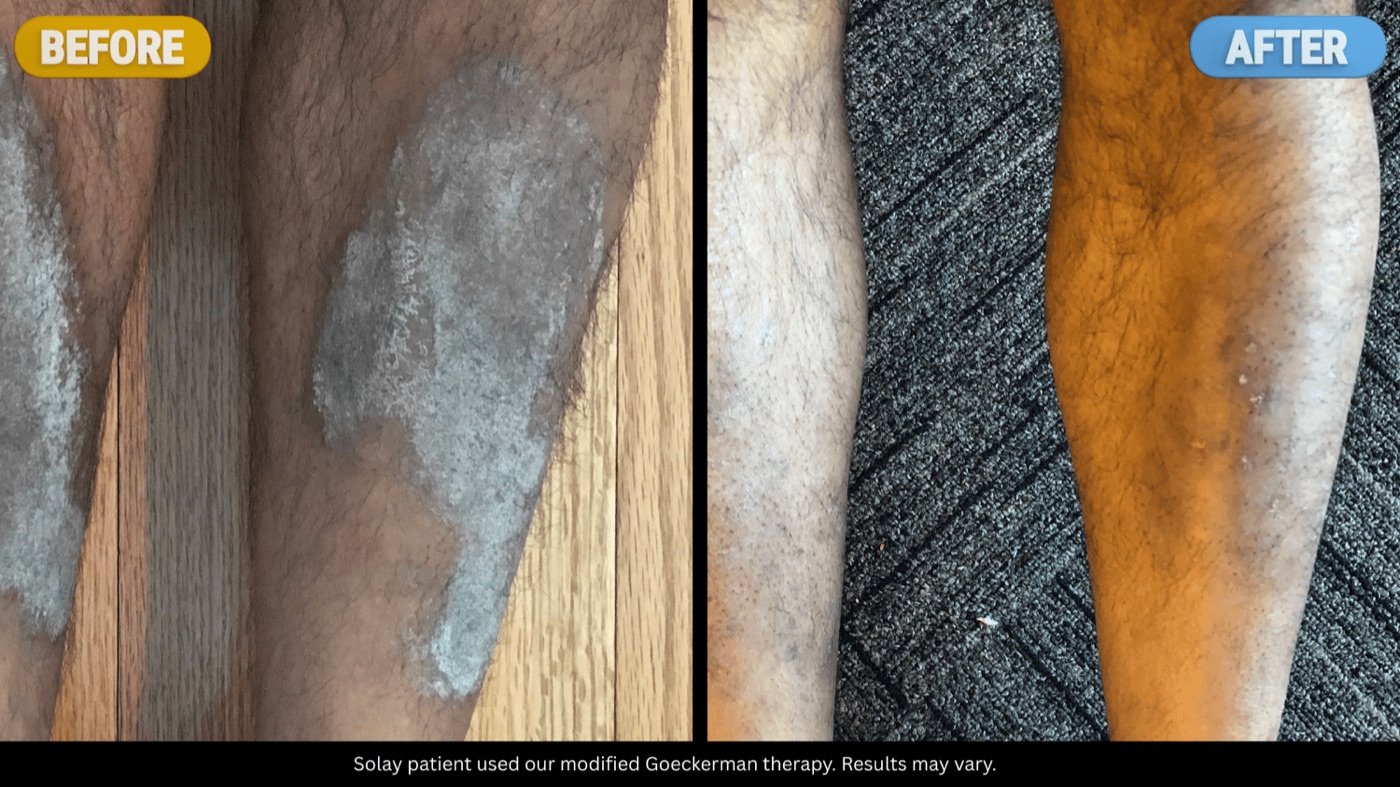
A 34-year-old man had lived with severe plaque psoriasis for over 10 years. Even after using a biologic therapy, he continued to have thick, scaly patches on his legs. After six weeks of completing an at-home version of Goeckerman therapy, his skin fully cleared, and he was able to stop using his previous medication.
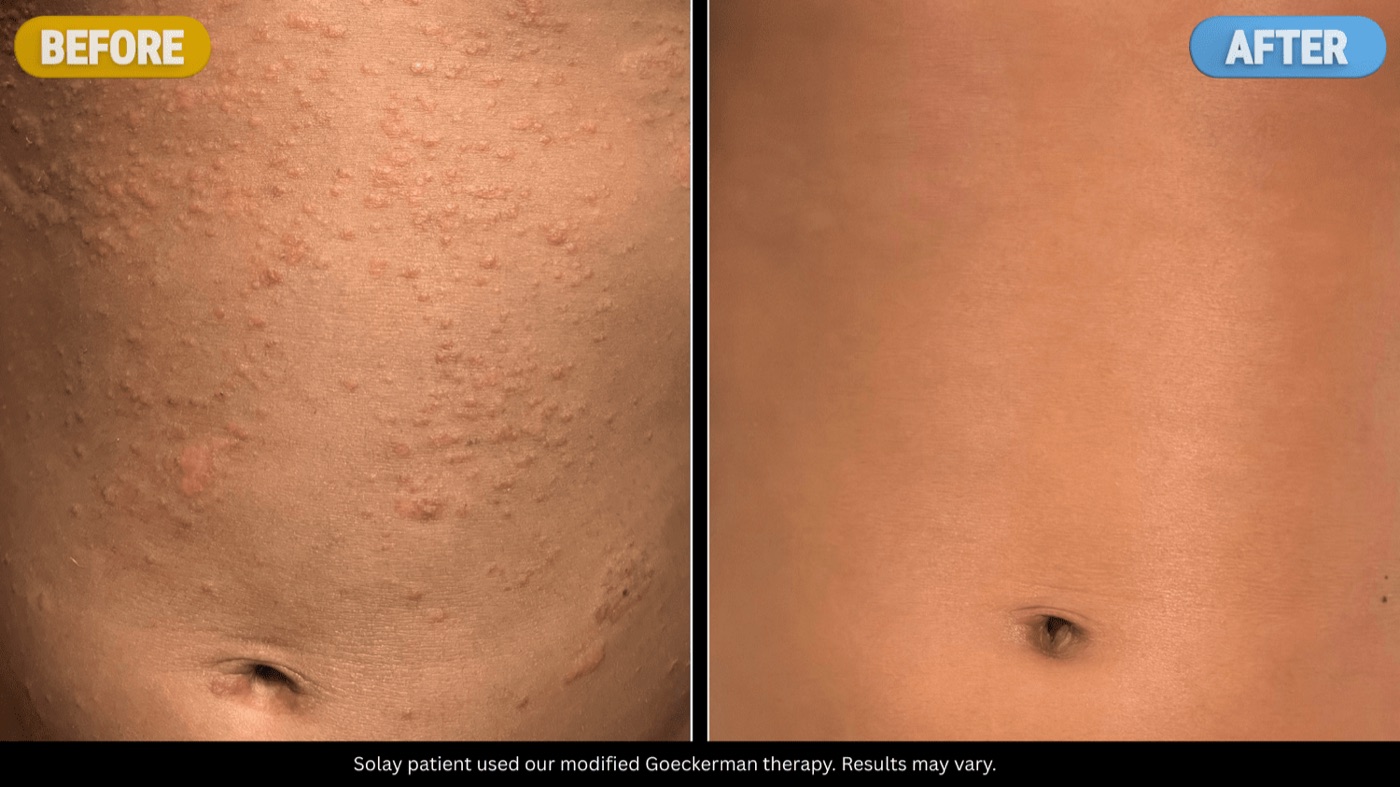
An 8-year-old girl had lived with severe psoriasis for four years. She was first treated with prescription steroid creams and UVB light therapy, which helped briefly but didn’t last. Her plaque psoriasis returned, and she developed guttate psoriasis as well. Although a biologic was recommended, her mother pursued Solay’s at-home Goeckerman therapy instead. Following treatment, both her plaque and guttate lesions resolved completely, resulting in sustained full remission and clear skin.
References
Gupta R et al. The Goeckerman regimen for the treatment of moderate to severe psoriasis. J Vis Exp. 2013 Jul 11;(77):50509
Lee E et al. Modern modified “ultra” Goeckerman therapy: PASI study. J Dermatolog Treat. 2005 Apr;16(2):102-7.
Menter A, Cram DL. The Goeckerman regimen in two psoriasis day care centers. Journal of the American Academy of Dermatology. 1983;9(1):59–65. doi:10.1016/S0190-9622(83)70107-6.
Fitzmaurice, S., Bhutani, T., & Koo, J. (2013). Goeckerman regimen for management of psoriasis refractory to biologic therapy: The University of California San Francisco experience. Journal of the American Academy of Dermatology, 69(4), 648–649.
Çaliskan E, Tunca M, Açikgöz G, Arca E, Yürekli A, Akar A. Narrow band ultraviolet-B vs Goeckerman therapy for psoriasis with and without acitretin: A retrospective study. Indian Journal of Dermatology, Venereology and Leprology. 2015;81(6):584-587. doi:10.4103/0378-6323.168329.
Coelho MMV, Apetato M. The dark side of the light: Phototherapy adverse effects. Clinics in Dermatology. 2016;34(5):556-562. doi:10.1016/j.clindermatol.2016.05.005.
Dennis M, Bhutani T, Koo J, Liao W. Goeckerman therapy for the treatment of eczema: A practical guide and review of efficacy. Journal of Dermatological Treatment. 2013;24(1):2-6. doi:10.3109/09546634.2011.607794.
Rome BN, Han J, Mooney H, et al. Use and cost of first-line biologic medications to treat plaque psoriasis in the US. JAMA Dermatol. 2025;161(6):622-628. doi:10.1001/jamadermatol.2025.0669.
Egilman AC, Kesselheim AS, Avorn J, et al. Use of efficiency frontiers to align prices and clinical benefits of biologic therapies for plaque psoriasis. JAMA Dermatol. 2024;160(4):409-416. doi:10.1001/jamadermatol.2023.6236.
De Miguel R, El-Azhary R. Efficacy, safety, and cost of Goeckerman therapy compared with biologics in the treatment of moderate to severe psoriasis. Int J Dermatol. 2009;48(6):653-658. doi:10.1111/j.1365-4632.2009.04012.x